Tlayudas Bring the Big Masa Energy We’re Looking For

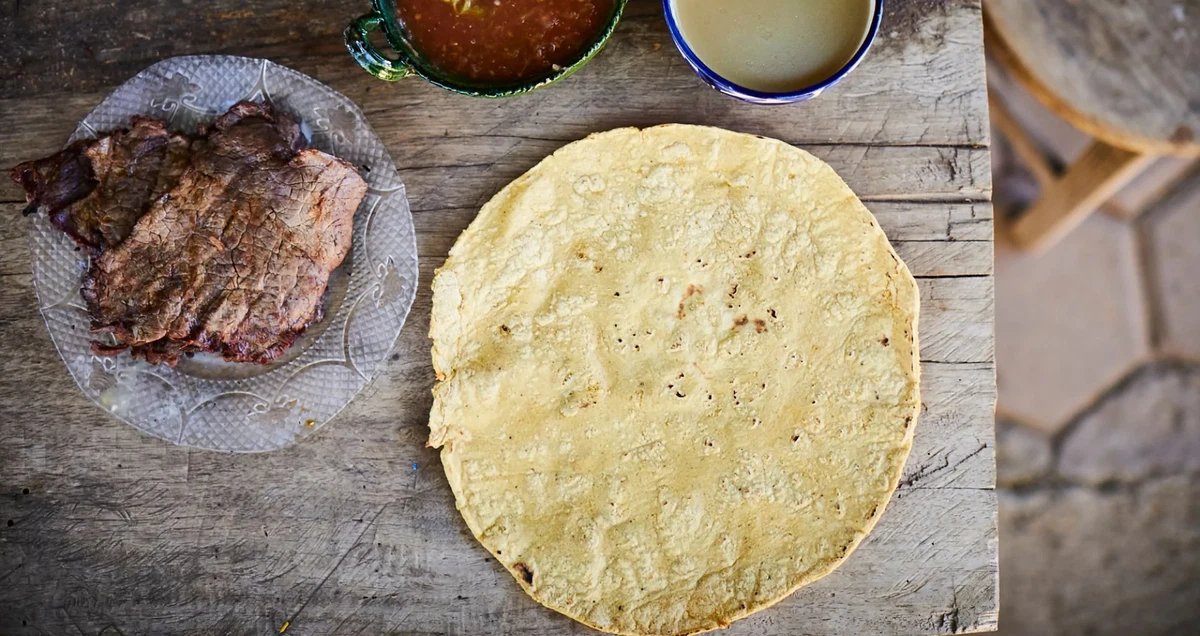
Tlayuda tortilla with a side of steak

Masa is a very agreeable companion. A willing muse and a team player, it adapts in texture and shape to fulfill your mealtime vision and let its co-stars shine on the plate.

But sometimes delicious masa needs its own moment to shine. To spread its wings, claim its territory and emphatically mark its spot on the table. Sometimes, masa needs a stage.

Enter the Tlayuda. A vast, sturdy canvas waiting to be adorned in whatever tapestries of flavor you can dream up.

What is a Tlayuda?

Tlayudas are large-format (up to 14 inches) tortillas that are often crisped, topped, and served open-faced (pizza style) or folded over (calzone style). These large-format tortillas appear in three distinct textures; however, only one of the three is technically called a tlayuda. That’s because the name itself refers to a specific level of cooking doneness of the tortilla: semi-toasted and ideal for folding and crisping up later on with asiento/fat, black bean purée, quesillo, thinly-sliced cabbage, and salsa tucked inside.

The tlayuda traces its roots to Oaxaca, the masa mecca of the world and believed by many to be the very birthplace of corn. The bolita corn varietal grows bountifully in the state’s Valles Centrales, essential for the structural integrity of tortillas of this size. When preparing masa for tlayudas, some producers will traditionally nixtamalize this corn in ash instead of cal.

Tlayudas are sometimes called clayudas, as the latter is considered easier to pronounce in English-speaking contexts. But we don't make fresh masa to take the easy way out, right? Give it a shot:

T-la-yu-da

You're a natural.

While freshly ground masa made from bolita corn is the ideal (at least, the most traditional), masa harina can indeed do the trick. That said, not all masa harina is created equal. We have found that most brands lack the structure to hold a masa shape of this size. So, if you're looking for the right fit for this application, Masienda's yellow masa harina is your best bet. Like all of our masa harina options, our yellow masa harina is made using whole heirloom corn that is gently cooked and slowly steeped in an alkaline bath--an ancient process known as nixtamalization. It is then carefully ground and slowly dried to preserve all of its nutrient density, flavor and natural aromas for a masa harina so good that you'll think it was fresh from the molino. ¡Provecho!
Our Tlayuda Recipe

Our Tlayuda Recipe

To cook a tortilla of the traditional tlayuda size requires a larger comal than many home cooks have on hand. A full-size (20 in [50 cm] or larger) comal or professional plancha will do the trick, or you can also scale the size down to your needs and liking.

Tlayuda-sized presses can be hard to find, so we partnered with Doña Rosa to make our own. Otherwise, you can fashion one yourself. Two heavy books, cutting boards, the flat bottoms of two pots or pans—you get the picture. Don’t let a lack of equipment get in the way of flattening that masa. Where there is a will, there is a way. You’ll need plastic liners with whatever you use.

Ingredients

  • Fresh masa

Directions

  1. Prepare masa from scratch or with a high-quality masa harina. Preheat the comal to medium-high heat.

  2. To prepare a full-size tlayuda, roll a tennis-ball-size ball about 21/2 in [6 cm]) of Table Tortilla Masa. Following the same process as for a Table Tortilla, press as if you were preparing a slightly thicker table tortilla (about 1/8 in [3 mm] thick).

  3. Lower the comal to medium heat. Carefully remove the top plastic wrap sheet and drape the tlayuda over the length of your forearm. In a sweeping, backhanded motion, place the uncooked tlayuda on the comal. Cook one side of the tlayuda for about 60 seconds. Flip and cook the second side for another 60 seconds. Flipping back and forth, cook until the tlayuda is firm but still pliable, about 7 minutes total. You can use a metal trivet on your comal to prevent burning, and you can also occasionally mist water over the tlayuda if you find it is drying out too fast. The goal is to eventually fold it over without it breaking in half—it will have a seemingly stale texture.

  4. Let cool completely if not using immediately.

  5. To serve, preheat a wood or gas grill on medium-high heat and briefly reheat both sides for 45 to 60 seconds.

  6. Remove and apply fat (traditionally asiento), beans, and cheese of your choice to one half of the surface. Fold the tlayuda in half without breaking it and return it to the grill, using tongs to keep the fold in place until it crisps and sets in position. If working with open flames, fan them to kiss the tlayuda lightly with color. Repeat on both sides until the tlayuda is crispy, nicely colored, and the fillings have nicely rendered and melted.

  7. Add any additional toppings to the center or top of the tlayuda, such as meat, salsa, and thinly shredded fresh cabbage, as is traditionally served. Enjoy while hot.

2 comments

BRYAN |

Do you have any tips for storing? I make tlayudas often but I notice they always dry up with lots of waves if that makes sense. How can I keep them flat when I store them?

RAFAEL ZAMORA |

Perfect recipe!! Loved it!

Leave a comment

Please note, comments need to be approved before they are published.